FPA Reflects on a Transformative 2025
Here are some of the year's key milestones, advocacy wins, and industry insights
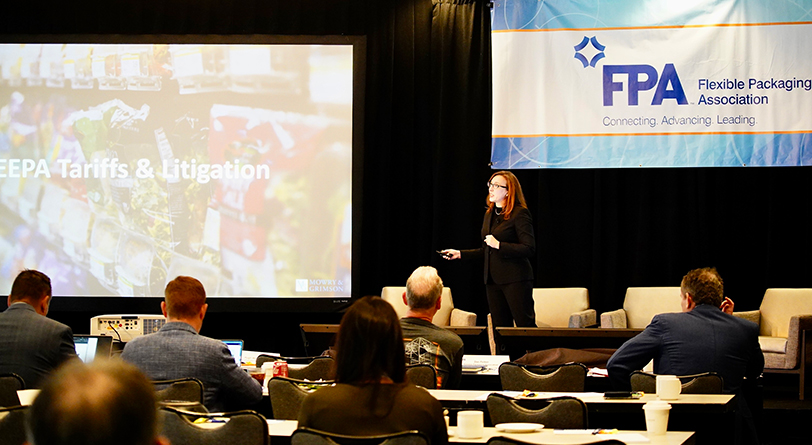
The Flexible Packaging Association (FPA) released its annual Report to the Members, providing a comprehensive overview of the initiatives, achievements, and strategic actions undertaken throughout 2025. As the leading voice of the U.S. flexible packaging industry for 75 years, FPA continues to serve as a vital resource—
offering advocacy, data, communication, and networking that strengthen member companies and support long-term industry growth.
The 2025 report underscores FPA’s mission and strategic commitments:
- Advocating for state and federal policies that drive innovation, protect against barriers to growth, and mitigate regulatory burdens;
- Promoting the sustainability and performance advantages of flexible packaging;
- Communicating consistently with members, policymakers, and stakeholders;
- Providing robust industry data to support informed decision-making; and
- Creating opportunities for collaboration, education, and relationship-building.
What follows is a summary of the significant developments and efforts highlighted in this year’s report.
Strong and Steady Advocacy in a Tumultuous Year
The year began with significant shifts at the federal level as President Donald J. Trump initiated a broad restructuring of government operations. Despite this volatility, the direct day-to-day impact on the flexible packaging sector—outside of tariff and trade concerns—was more measured than expected. Some deregulatory momentum emerged within federal agencies, and Congress, constrained by narrow margins in both chambers, focused largely on budget negotiations rather than sweeping legislative changes.
As in past years, however, the most consequential policy activity for FPA members unfolded in state capitals. FPA tracked 367 bills across 36 states during the first year of the 2025–2026 legislative cycle. Of these, 40 bills in 16 states focused on extended producer responsibility (EPR)—one of FPA’s top legislative priorities.
EPR and State-Level Engagement
Following a surge of activity in 2023–2024, during which FPA monitored more than 500 packaging-related bills, EPR remained a dominant issue of concern in 2025. FPA staff and consultants were heavily engaged in shaping these proposals to ensure that flexible packaging’s unique sustainability profile and role in the circular economy were accurately represented. We saw two more states—Maryland and Washington—enact packaging EPR bills in 2025. The association also continued its work on related state-level issues, including labeling standards, restrictions on per- and polyfluoroalkyl substances, and policies affecting advanced recycling.
Federal Action: Advancing a National Recycling Framework
At the federal level, FPA continued to push for a national strategy to harmonize and strengthen recycling systems, enhance infrastructure, and establish consistent labeling standards. A key milestone came on July 16, 2025, when FPA President and CEO Dan Felton testified before the U.S. House Energy and Commerce Subcommittee on Environment at a hearing on the future of recycling in America.
Two priority bills for FPA—the Recycling and Composting Accountability Act and the Recycling Infrastructure and Accessibility Act—were reintroduced in 2025 as stand-alone bills in the House. They were combined and introduced as one bill, the Strategies To Eliminate Waste and Accelerate Recycling Development, or STEWARD, Act of 2025 (S.351), in the Senate. The legislation would:
- Create a pilot grant program at the U.S. Environmental Protection Agency (EPA) to expand recycling access in underserved communities;
- Authorize the EPA to collect and analyze comprehensive national data on recycling and composting; and
- Evaluate barriers, infrastructure needs, and market trends in composting nationwide.
The STEWARD Act passed the full Senate in late November, with further action in the House pending at the time of this writing.
Another federal priority is the Packaging and Claims Knowledge (PACK) Act that would establish uniform national definitions and criteria for recyclable, compostable, and reusable packaging claims. FPA supports this initiative from AMERIPEN—American Institute for Packaging and the Environment. The bill also aims to preempt conflicting state laws, which would reduce compliance complexity for packaging producers. The PACK Act was introduced in the House by Congressman Randy Weber (TX-14) on December 17, 2025.
FPA will continue to monitor and engage on federal and state policy proposals throughout 2026 to ensure the industry’s voice is clearly heard.
Strengthening Governance: The New FPA Government Affairs Committee
In 2025, FPA officially sunsetted its Circularity Committee and launched a more comprehensive Government Affairs Committee (GAC). This new committee expands FPA’s policy engagement by:
- Identifying top federal and state advocacy priorities;
- Enhancing public policy communications;
- Developing FPA’s “fly-in” capacity for member engagement in Washington, D.C.; and
- Coordinating industry responses to emerging policy challenges.
During its inaugural year, GAC developed a formal charter and began evaluating high-priority topics, including federal greenhouse gas reporting frameworks and a Department of Justice Request for Information. It also received updates on a potential lawsuit challenging California’s SB 343 (the “truth in labeling” law) and began outlining positions on key issues that may shape future industry strategies.
Tariff Working Group: A New Forum for Trade and Market Intelligence
With tariff and trade activity becoming increasingly dynamic, FPA established a dedicated Tariff Working Group in June 2025. Composed of more than 20 representatives from member companies, the group meets monthly to:
- Share market intelligence;
- Identify the impact of tariffs on supply chains;
- Help guide FPA’s coalition work and information
sharing; and - Develop coordinated industry responses to federal trade actions.
This group has already proved valuable by ensuring that member perspectives are front and center as FPA navigates ongoing tariff developments and potential regulatory shifts.
Delivering High-Value Industry Data and Market Insights
FPA remains the leading source of comprehensive data on the U.S. flexible packaging industry. Ongoing collaboration with the U.S. Census Bureau, the Departments of Labor and Commerce, the Bureau of Economic Analysis, investment analysts, and partners strengthens the accuracy and depth of the association’s statistical products.
Industry Report
FPA’s annual flagship report, the State of the U.S. Flexible Packaging Industry Report, once again provides a detailed overview of market performance, trends, and economic indicators. According to U.S. Census data compiled by FPA:
The U.S. flexible packaging industry reached $42.6 billion in sales in 2024, up 2.9% from the previous year;
This growth nearly matched U.S. gross domestic product, which rose 2.8% over the same period; and
Flexible packaging accounts for 20% of the $213.4 billion U.S. packaging market, ranking second only to corrugated paper.
The report also includes analyses of profitability, capital investment trends, end-use markets, imports and exports, and mergers and acquisitions—making it a trusted resource for converters, suppliers, investors, and analysts alike.
Economic Impact: New Study Highlights Industry Value
A new study conducted for FPA by John Dunham & Associates further demonstrates the industry’s economic significance. In 2025, the flexible packaging industry was projected to:
- Generate $51.5 billion in direct economic output;
- Support 98,400 direct jobs; and
- Contribute $8.7 billion in labor income (wages and benefits).
These findings reinforce both the industry’s national footprint and its critical role in modern supply chains.
Dani Diehlmann is FPA vice president, communications.